Make a graphical interface with PyQt?
A PyQt program always has the same three steps: create the application object, create your window, show the window. Once you know these three lines you can add any widget you like.
Graphical interfaces made with PyQt run on: Microsoft Windows, Apple Mac OS X and Linux. We will create a Hello World app with PyQt.
PyQt installation
PyQt is available for both Python 2 (2.7.9 tested) and Python 3.
To install write:
pip3 install pyqt5
With apt-get you can use: python3-pyqt5
PyQt hello world
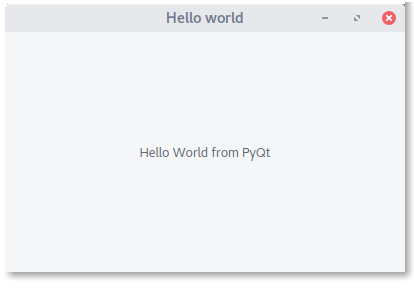
The app we write will show the message “Hello World” in a graphical window. Import the PyQt5 module.
# https://pythonprogramminglanguage.com/pyqt5-hello-world/ |
The program starts in the main part.
We initialize Qt and create an object of the type HelloWindow.
We call the show() method to display the window.
if __name__ == "__main__": |
The HelloWindow class inherits from the class QMainWindow.
We call its super method to initialize the window.
Several class variables are set: size and window title.
We add widgets to the window, including a label widget (QLabel) which displays the message “Hello World”.
The three steps
app = QtWidgets.QApplication(sys.argv)creates the application. There is exactly one per program.w = QtWidgets.QMainWindow()creates the window, or a QWidget for something simpler.w.show()makes it visible.sys.exit(app.exec_())hands control to Qt and keeps the program running.
Widgets are added to a layout, never placed with coordinates. A QVBoxLayout stacks them vertically and a QHBoxLayout puts them next to each other. The layout keeps things in place when the window is resized.
Install with pip install PyQt5. On Debian you can also use
apt-get install python3-pyqt5.
If you want to try this yourself, the exercises on PyChallenge turn the same idea into a few short problems with instant feedback.